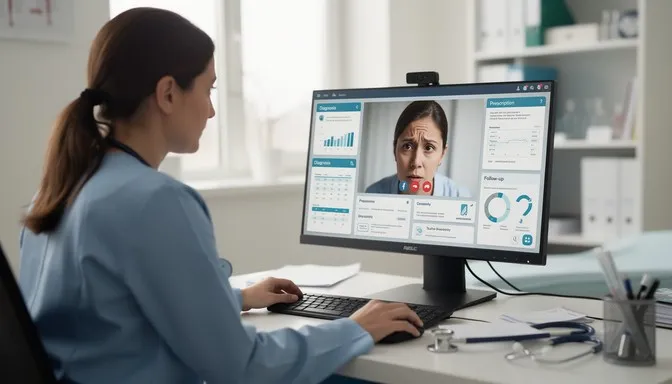
Why Your Online Doctor Wants to See You Again—And What That Says About the Quality of Your Care

Photo: Shixart1985, CC BY 2.0, via Wikimedia Commons
There is a common misconception that telemedicine operates like a vending machine: you describe a symptom, receive a prescription, and the interaction concludes. For straightforward, self-limiting conditions, that picture is not entirely inaccurate. But for the vast majority of clinical encounters—those involving new medications, unresolved symptoms, or conditions that evolve over days and weeks—your licensed online physician will almost certainly want to check in again. That follow-up request is not a limitation of virtual care. It is evidence that your doctor is doing their job correctly.
The Clinical Logic That Drives Every Follow-Up Recommendation
Physicians—whether they are seated across a desk or appearing on a video screen—are trained to think in timelines. A diagnosis is rarely a single, static conclusion. It is a working hypothesis that must be tested against how a patient actually responds to treatment. When a physician prescribes an antibiotic, a blood pressure medication, or an inhaler, they are making an educated clinical judgment based on the information available at that moment. The follow-up appointment is how they close the feedback loop.
Consider a patient who consults a physician through Doctor7 Online for a suspected sinus infection. The physician reviews the symptom history, asks clarifying questions, and prescribes a course of antibiotics. A week later, the same physician schedules a brief follow-up call. Why? Because sinus infections that do not respond to a standard antibiotic course may indicate bacterial resistance, a deeper structural issue, or—critically—a misdiagnosis. The follow-up is not administrative box-checking. It is active surveillance against the possibility that the initial treatment plan was incomplete.
Medication Monitoring: The Follow-Up's Most Important Function
Among the most clinically significant reasons for scheduled follow-up visits is medication management. Many commonly prescribed drugs—including antidepressants, antihypertensives, and thyroid medications—require time to reach therapeutic levels in the body, and their effectiveness can only be accurately assessed after a defined period of use.
Beyond effectiveness, physicians must also monitor for adverse effects. A patient who begins a new medication may not immediately recognize that the fatigue they are experiencing, or the mild gastrointestinal discomfort, is directly tied to their prescription. An online physician who schedules a follow-up within the appropriate clinical window can catch these reactions early, adjust the dosage, switch to an alternative medication, or provide reassurance that the side effects are temporary and expected.
This kind of proactive monitoring has historically been one of the arguments against telemedicine—the idea that virtual physicians could not adequately track a patient's response to treatment. That argument has been largely dismantled by the sophistication of modern virtual care platforms, which allow physicians to review patient-reported outcomes, request laboratory results, and conduct structured symptom assessments between formal appointments.
When a Follow-Up Means an In-Person Referral
Not every follow-up stays virtual. A responsible online physician will sometimes use a follow-up consultation to determine that a patient requires hands-on evaluation or diagnostic testing that cannot be performed remotely. This is not a failure of telemedicine—it is telemedicine functioning exactly as it should.
A patient reporting chest discomfort that has not resolved after several days, for example, may initially present with a pattern consistent with musculoskeletal strain or acid reflux. If a follow-up reveals that the discomfort is changing in character, radiating differently, or accompanied by new symptoms, a licensed physician will refer that patient to an emergency department or a cardiologist without hesitation. The virtual encounter becomes a critical triage point rather than a dead end.
This layered approach to care—using virtual consultations to monitor, assess, and triage—represents one of the most underappreciated strengths of a well-designed telemedicine platform.
Continuity of Care: The Concept That Changes Everything
American healthcare has long struggled with fragmentation. Patients see one physician for a primary complaint, another for a specialist referral, and a third in an urgent care setting when their regular doctor is unavailable. Medical histories get lost. Treatment decisions are made without full context. Medications interact in ways no single prescriber was positioned to anticipate.
The follow-up appointment in a telemedicine setting works against this fragmentation. When a patient returns to the same physician on Doctor7 Online for a scheduled check-in, that physician already has the full context of the prior visit. They know what was prescribed, what concerns were raised, and what the treatment goals were. That continuity is clinically valuable in ways that are difficult to overstate.
Research published in health services literature consistently demonstrates that patients who maintain ongoing relationships with a single physician—rather than cycling through episodic, disconnected encounters—experience better health outcomes, higher medication adherence, and earlier detection of complications. The telemedicine follow-up is a structural mechanism for building that relationship in a virtual environment.
What Patients Should Do Before a Follow-Up Visit
To make the most of a scheduled follow-up with your online physician, preparation matters. Before logging in, take note of any changes in your symptoms since your last visit—both improvements and new developments. If you were prescribed a medication, document when you began taking it, whether you have taken it consistently, and any side effects you have noticed. If you use a home monitoring device, such as a blood pressure cuff or a pulse oximeter, record your recent readings.
This information transforms a follow-up from a brief check-in into a genuinely productive clinical encounter. Your physician can use it to make evidence-based adjustments to your care plan rather than relying solely on your real-time recall during the appointment.
Rethinking the Follow-Up as a Feature
The cultural expectation in American healthcare has often been that a good doctor visit resolves the problem in a single encounter. That expectation, while understandable, is not always clinically realistic. The human body does not follow neat timelines, and medicine rarely offers the certainty that patients—and physicians—wish it would.
When your licensed online physician at Doctor7 Online recommends a follow-up appointment, they are not signaling uncertainty about their competence. They are signaling commitment to your outcome. They are acknowledging that medicine is an ongoing process, not a transaction. And they are doing precisely what the best physicians in the country—virtual or otherwise—have always done: staying with their patients through the full arc of care.
That is not a paradox. That is good medicine.